Taskmate

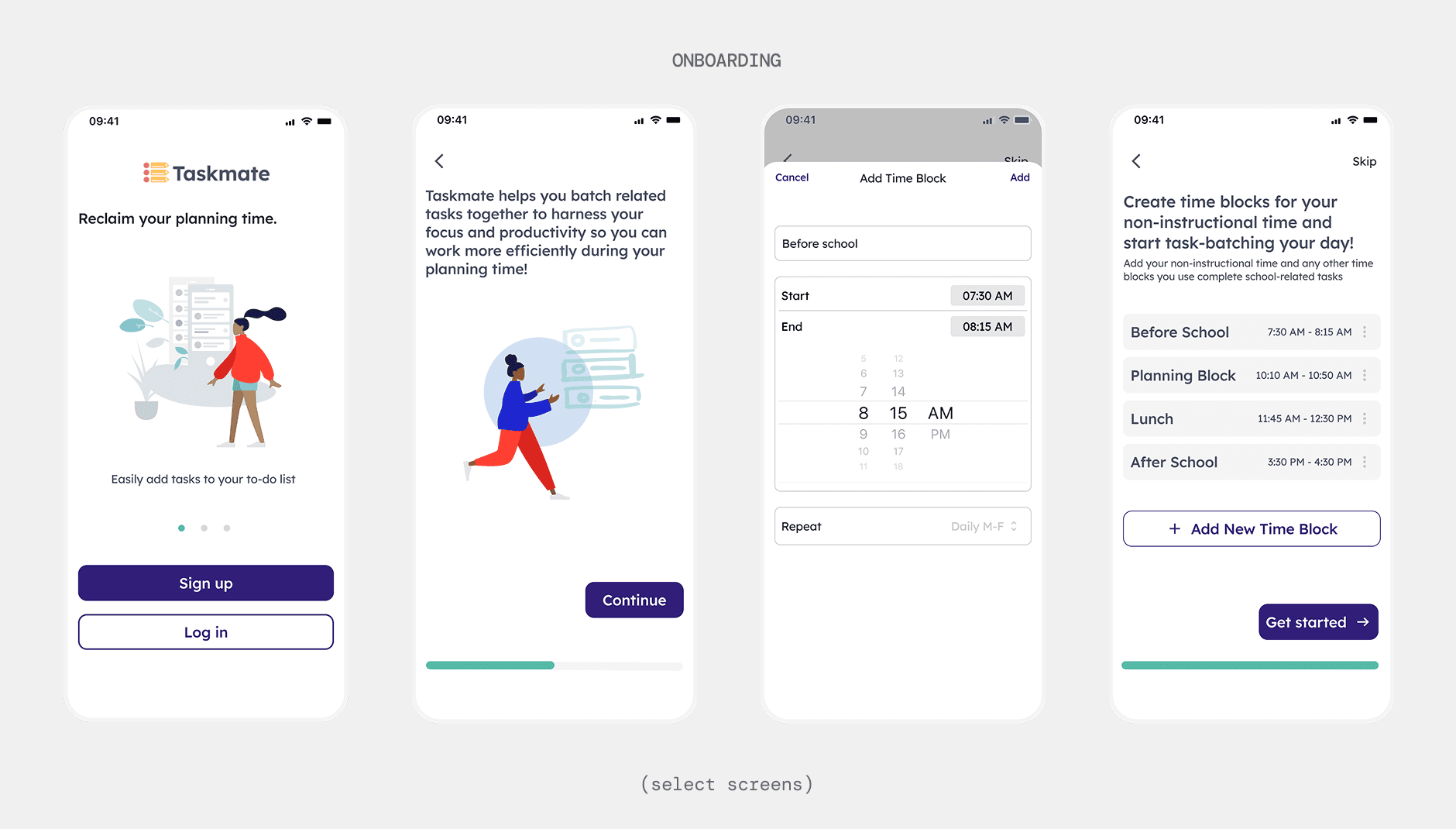
For my final end-to-end project of DesignLab's UX Academy, I designed a mobile productivity app aimed to help teachers prioritize tasks to make the most efficient use of their non-instructional time. Using a combination of research-backed productivity hacks, Taskmate allows teachers to bask similar types of tasks and assign them to a time block to ensure no tasks are left behind.

8 weeks | Spring 2023
A task management app designed to help teachers take back control of their time.

Overview

As a teacher-turned-designer with a deep love for systems and structure, I’ve always been curious about how people organize their lives. While teaching, I noticed every colleague had their own way of juggling tasks—sticky notes, spreadsheets, calendars, notes scribbled on the palm of their hand, or just sheer memory.

That curiosity led to Taskmate, a conceptual mobile app to help teachers manage their non-instructional time more efficiently so they can focus on what matters most and maybe catch their breath between the chaos.

Role

Solo UX/UI designer

Tools

Figma/FigJam
Dovetail
Maze

Context

They say teaching is like having a hundred balls thrown at you all at once—and someone just yells ‘CATCH!

If you’ve ever worked in a school, that metaphor hits hard. Between lesson planning, student needs, behavior management, admin requests, parent emails, and unexpected events, teaching often feels like organized chaos. And while instruction takes center stage, teachers’ non-instructional time is the lifeline—yet it’s often scattered, inconsistent, or eaten up by last-minute tasks.

💡 On average, elementary teachers only get 47 minutes of planning time per day—about 10% of their day.

The challenge? You can’t make more time without systemic change. But what if we could help teachers use their existing time more effectively? What if they could clearly see what’s on their plate—and tackle it with clarity and confidence?

If you’ve ever worked in a school, that metaphor hits hard. Between lesson planning, student needs, behavior management, admin requests, parent emails, and unexpected events, teaching often feels like organized chaos. And while instruction takes center stage, teachers’ non-instructional time is the lifeline—yet it’s often scattered, inconsistent, or eaten up by last-minute tasks.


💡 On average, elementary teachers only get 47 minutes of planning time per day—about 10% of their day.

The challenge? You can’t make more time without system
ic change. But what if we could help teachers use their existing time more effectively? What if they could clearly see what’s on their plate—and tackle it with clarity and confidence?

If you’ve ever worked in a school, that metaphor hits hard. Between lesson planning, student needs, behavior management, admin requests, parent emails, and unexpected events, teaching often feels like organized chaos. And while instruction takes center stage, teachers’ non-instructional time is the lifeline—yet it’s often scattered, inconsistent, or eaten up by last-minute tasks.


💡 On average, elementary teachers only get 47 minutes of planning time per day—about 10% of their day.

The challenge? You can’t make more time without systemic change. But what if we could help teachers use their existing time more effectively? What if they could clearly see what’s on their plate—and tackle it with clarity and confidence?

Problem

Teachers need a better way to manage and prioritize tasks during their limited non-instructional time to reduce burnout and work more efficiently.

Without a solid system, tasks pile up. Priorities get fuzzy. Stress becomes the norm. And burnout is inevitable.

Without a solid system, tasks pile up. Priorities get fuzzy. Stress becomes the norm. And burnout is inevitable.

Without a solid system, tasks pile up. Priorities get fuzzy. Stress becomes the norm. And burnout is inevitable.

Solution

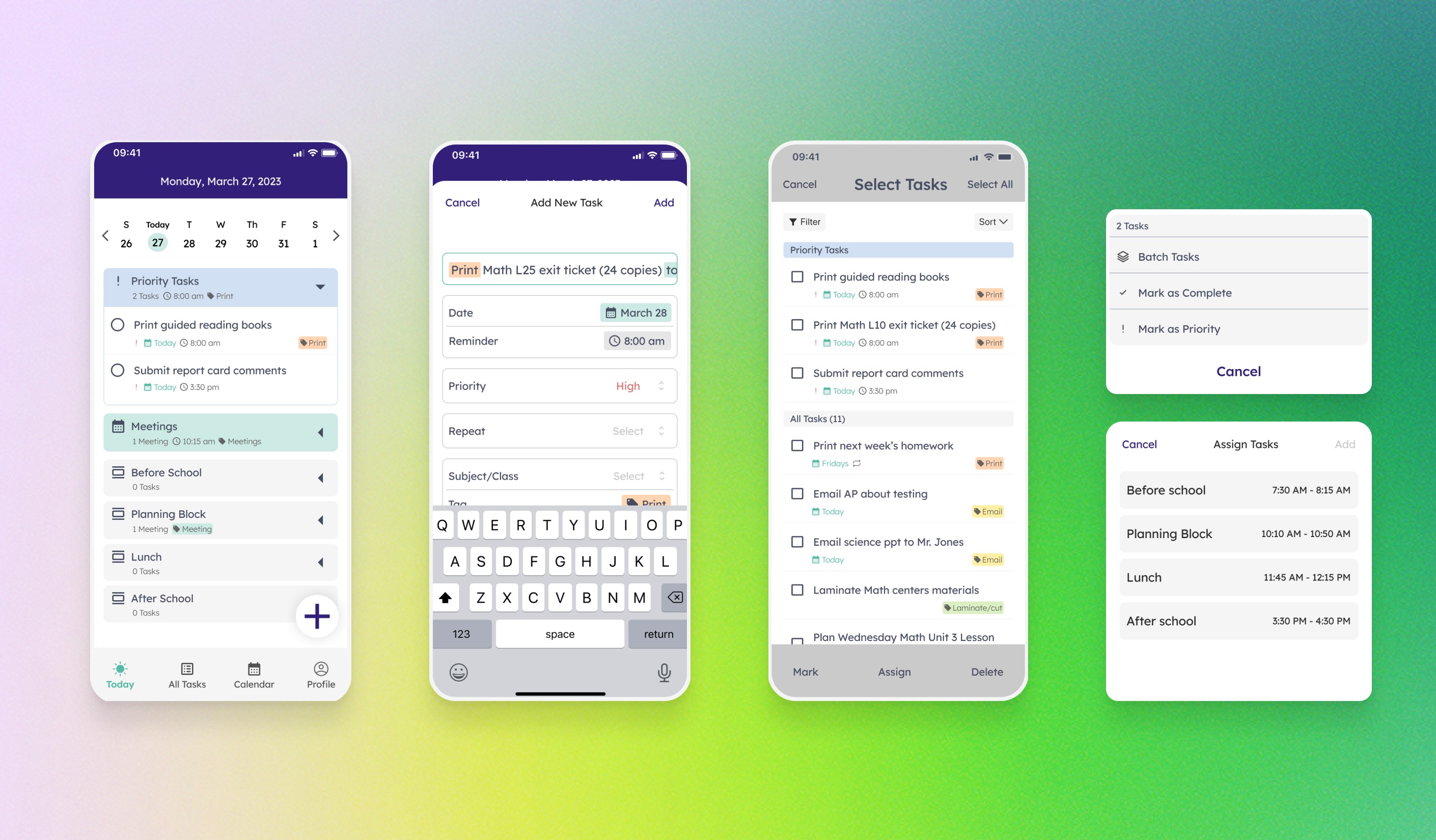
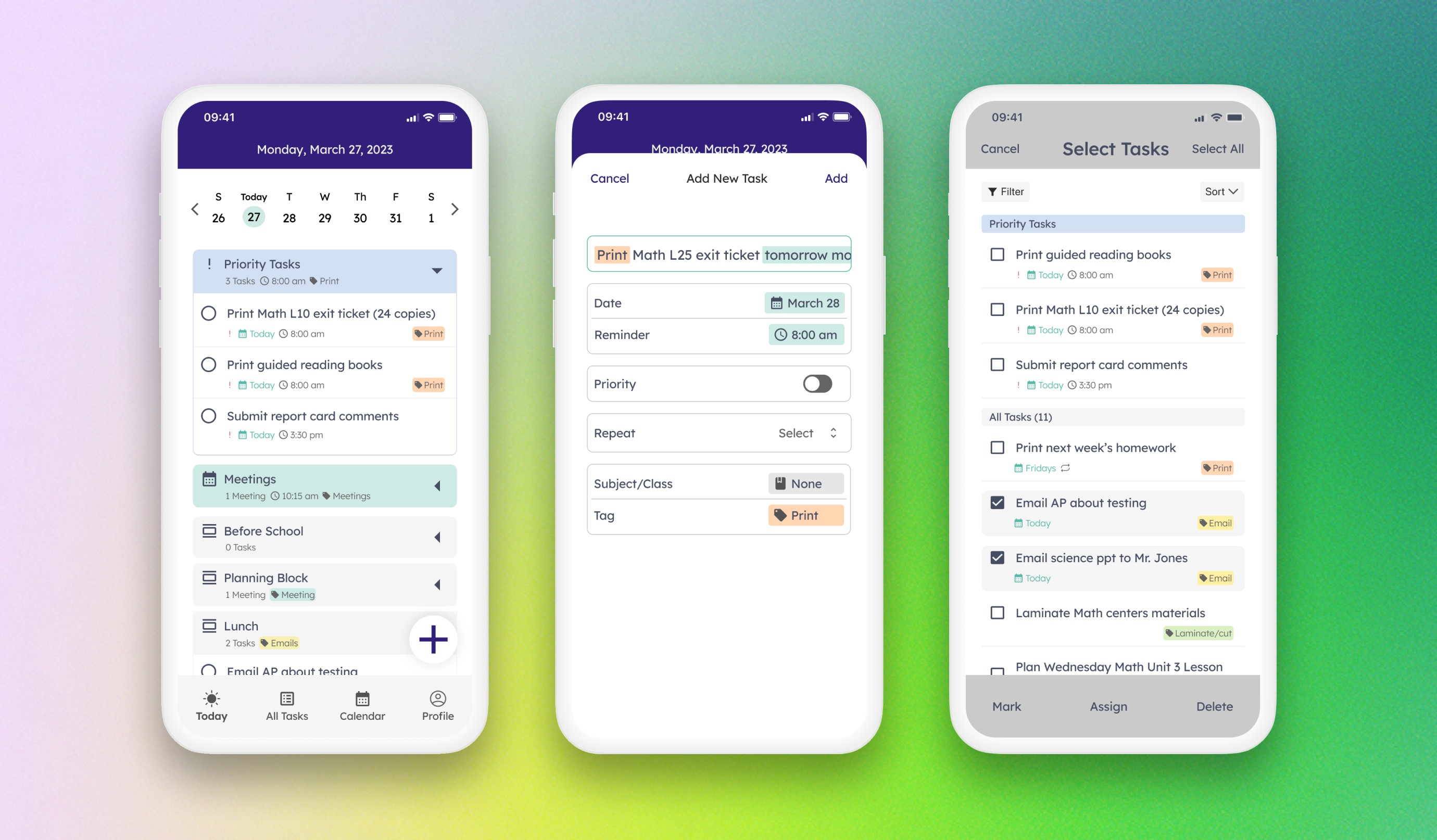
Taskmate combines task batching and time blocking to help teachers stay on task and on track with their to-do list.

The image featured at the top of the about us page #2
The image featured in the middle of the about us page

Research and Discovery

How might we help teachers prioritize and actually complete tasks?

As a former teacher, I came into this project with lived experience—but I didn’t want to rely on assumptions. So I interviewed 10 teachers from different backgrounds (early childhood to high school, across public, private, and charter schools).

A few consistent pain points stood out:

  • Unplanned interruptions from admin, students, or parents derailed their workflow.

  • Prioritizing tasks was key, but hard to maintain.

  • Organizational systems that once worked no longer kept up with their current pace.

Key insights:

  1. Teachers preferred doing certain types of tasks at specific times of day.

  2. Experienced teachers often abandoned older systems that no longer served them.

  3. Almost all participants agreed: prioritization is the key skill that most teachers say is important to learn early on in their career.

As a former teacher, I came into this project with lived experience—but I didn’t want to rely on assumptions. So I interviewed 10 teachers from different backgrounds (early childhood to high school, across public, private, and charter schools).

A few consistent pain points stood out:

  • Unplanned interruptions from admin, students, or parents derailed their workflow.

  • Prioritizing tasks was key, but hard to maintain.

  • Organizational systems that once worked no longer kept up with their current pace.

Key insights:

  1. Teachers preferred doing certain types of tasks at specific times of day.

  2. Experienced teachers often abandoned older systems that no longer served them.

  3. Almost all participants agreed: prioritization is the key skill that most teachers say is important to learn early on in their career.

As a former teacher, I came into this project with lived experience—but I didn’t want to rely on assumptions. So I interviewed 10 teachers from different backgrounds (early childhood to high school, across public, private, and charter schools).

A few consistent pain points stood out:

  • Unplanned interruptions from admin, students, or parents derailed their workflow.

  • Prioritizing tasks was key, but hard to maintain.

  • Organizational systems that once worked no longer kept up with their current pace.

Key insights:

  1. Teachers preferred doing certain types of tasks at specific times of day.

  2. Experienced teachers often abandoned older systems that no longer served them.

  3. Almost all participants agreed: prioritization is the key skill that most teachers say is important to learn early on in their career.

Secondary Research

What does productivity research say?

Curious about the science behind productivity, I explored studies on focus, multitasking, and time management. A few key takeaways:

Curious about the science behind productivity, I explored studies on focus, multitasking, and time management. A few key takeaways:

Curious about the science behind productivity, I explored studies on focus, multitasking, and time management. A few key takeaways:

Multitasking reduces productivity and increases stress.

Context-switching (jumping between unrelated tasks) drains cognitive energy.

Task batching (grouping similar tasks together) improves focus and completion.

Inspired by both qualitative and quantitative research, I began brainstorming ways to help teachers take control of their non-instructional time.


The goal was to help teachers use the time they already have more strategically.

Inspired by both qualitative and quantitative research, I began brainstorming ways to help teachers take control of their non-instructional time.


The goal was to help teachers use the time they already have more strategically.

Curious about the science behind productivity, I explored studies on focus, multitasking, and time management. A few key takeaways:

  • Multitasking actually reduces productivity and increases stress.

  • Context-switching (jumping between unrelated tasks) drains cognitive energy.

  • Task batching (grouping similar tasks together) improves focus and completion.

Inspired by both qualitative and quantitative research, I began brainstorming ways to help teachers take control of their non-instructional time.


The goal was to help teachers use the time they already have more strategically.

User Flows

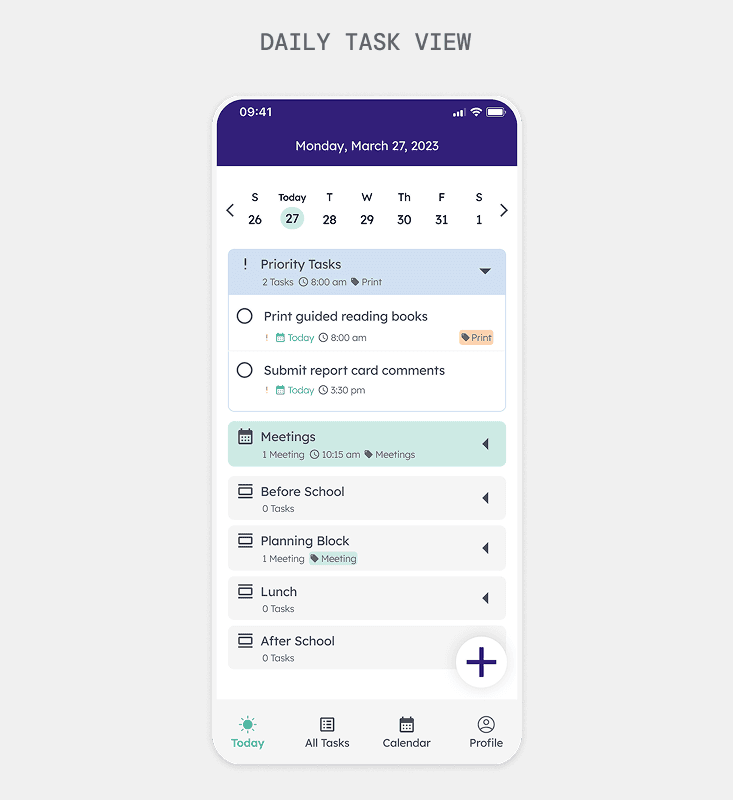
To guide the MVP, I identified three core flows:

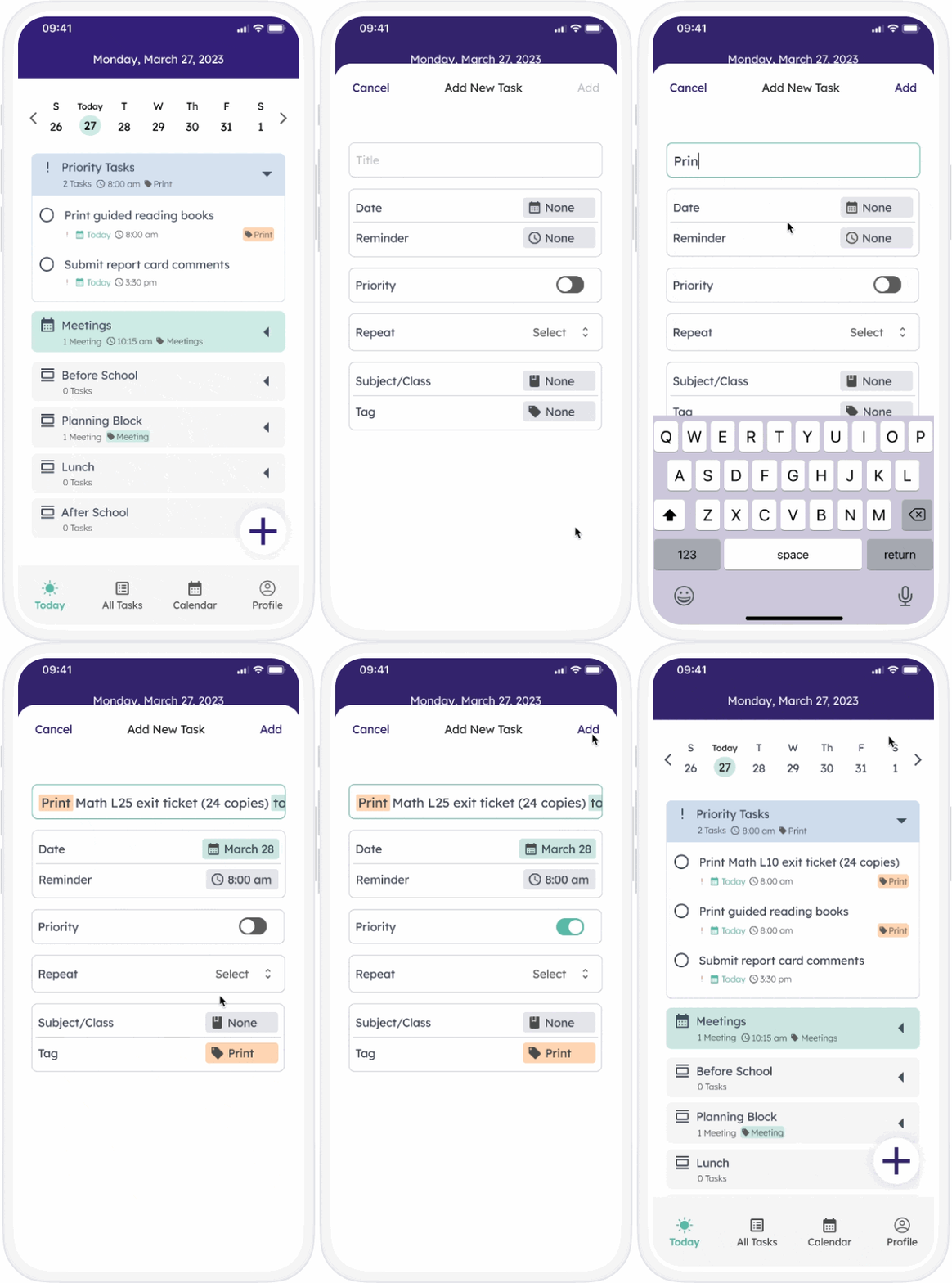
  1. Add a Task

    • Natural language input makes it quick and easy.

    • Users can tag, prioritize, and set reminders.

  2. Schedule a Task

    • Assign tasks to specific time blocks based on a teacher’s daily rhythm.

    • Focused time = focused energy.

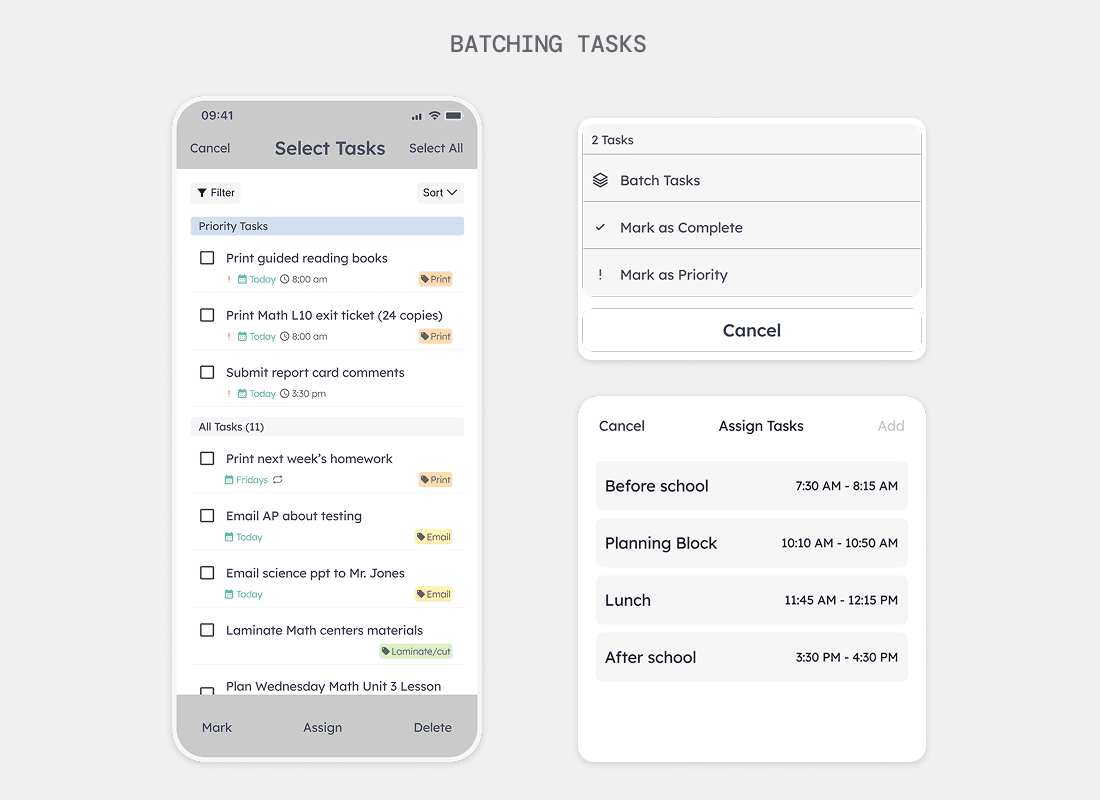
  3. Batch & Complete Tasks

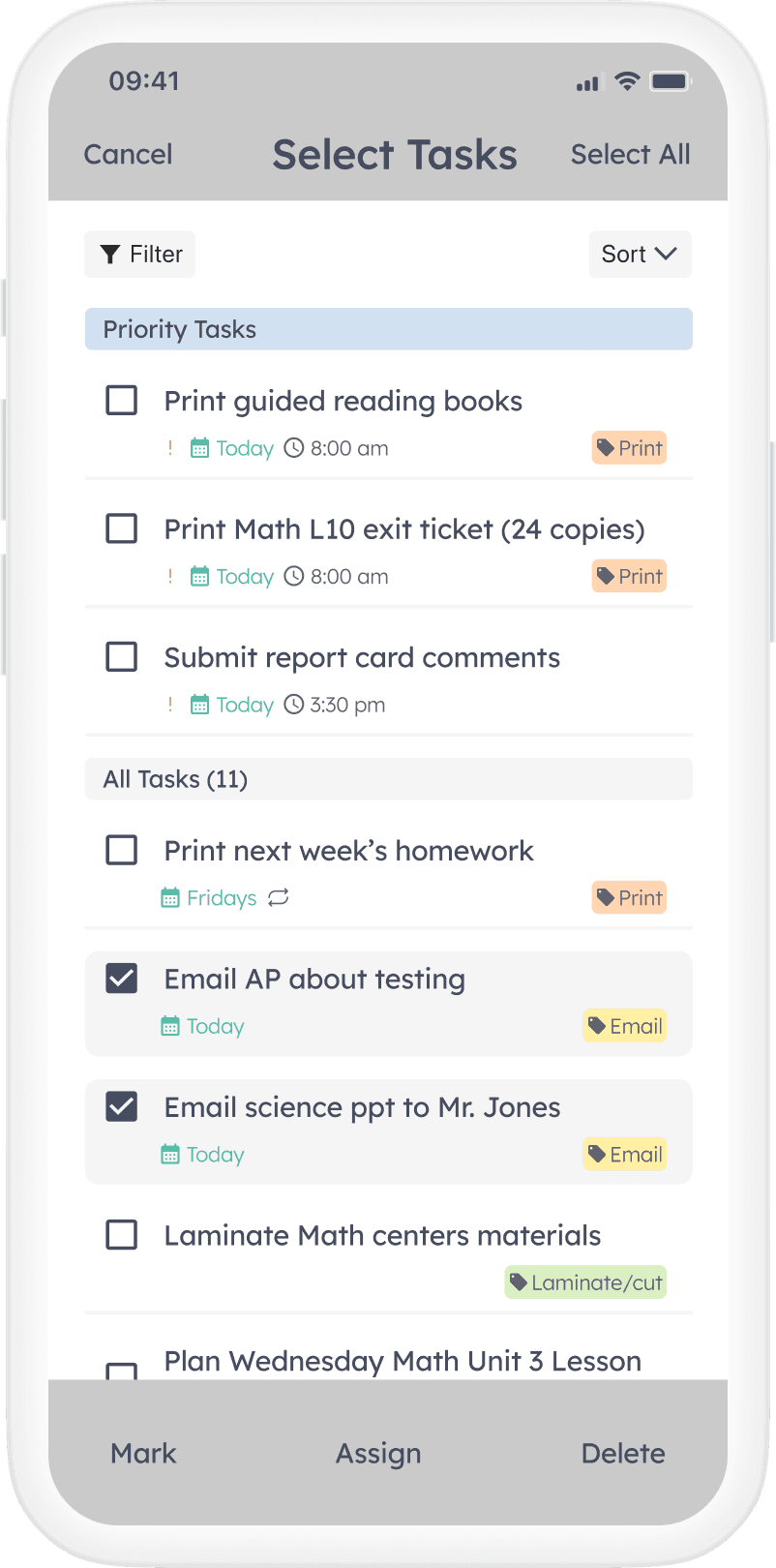
    • Users can group similar tasks together and knock them out in one go.

    • Batching = less context-switching = more flow.

Interface Design
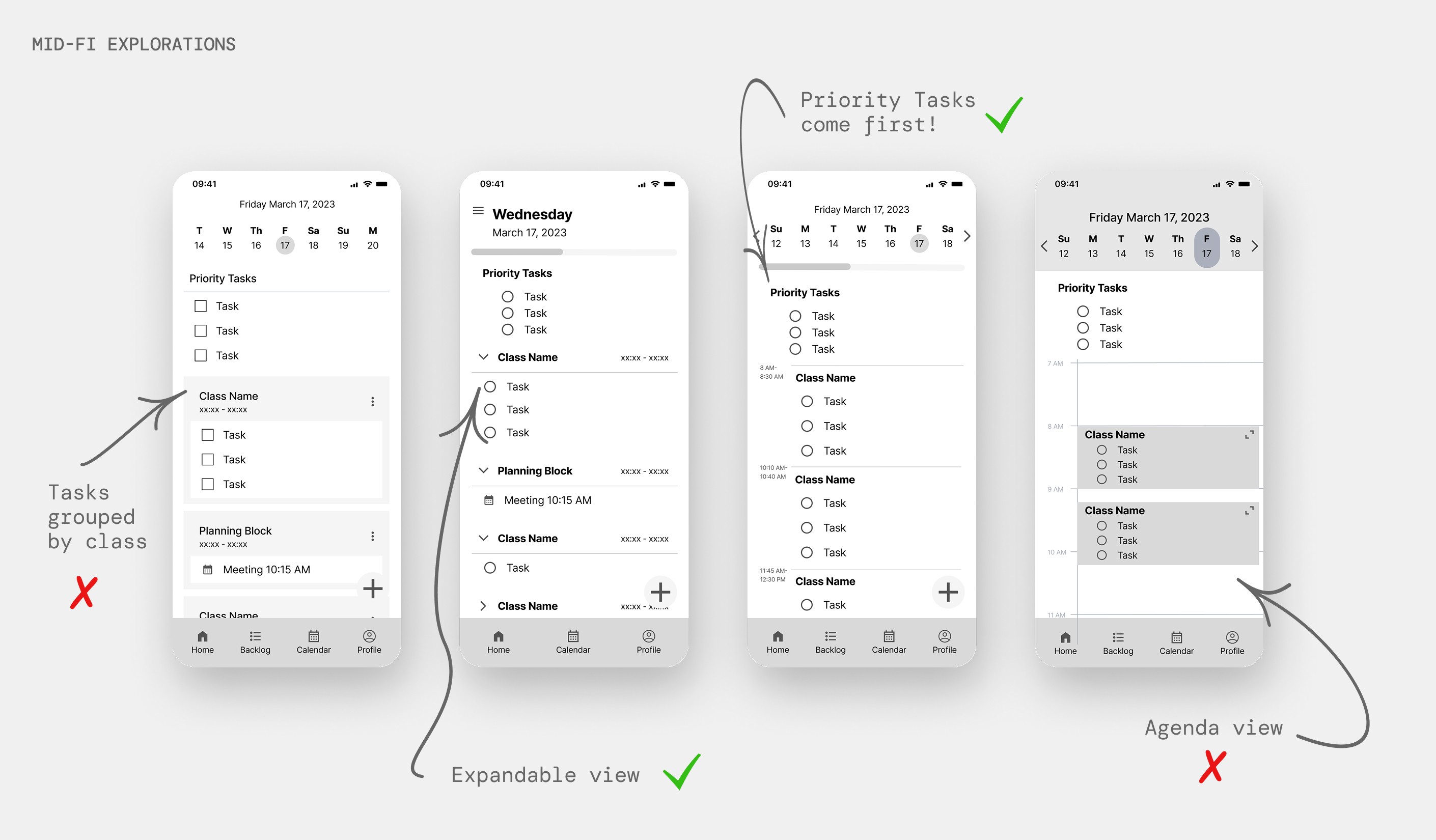
I started with low- and mid-fidelity wireframes that organized tasks by class or subject, but something didn’t sit right. While class or subject is surely one way to categorize tasks, it didn’t align with how teachers actually manage their time. Plus, teachers don't get a separate time block to plan for each lesson or class—they typically get ONE chunk of time to plan for EVERYTHING.

So I went back to the drawing board.

🤔 What didn’t work:

  • Organizing tasks by class looked tidy but didn’t match real-world time constraints.

  • It ignored the reality that non-instructional time is often fragmented and unpredictable.

✅ What did work:

  • Shifting the system toward task batching and time blocking based on energy and focus levels.

  • Helping users complete similar tasks during uninterrupted pockets of time.

This shift led to a key hypothesis:

If teachers can batch similar tasks and schedule them during focused time blocks, they’ll be more likely to complete them without burnout.

I started with low- and mid-fidelity wireframes that organized tasks by class or subject, but something didn’t sit right. While class or subject is surely one way to categorize tasks, it didn’t align with how teachers actually manage their time. Plus, teachers don't get a separate time block to plan for each lesson or class—they typically get ONE chunk of time to plan for EVERYTHING.

So I went back to the drawing board.


🤔 What didn’t work:

  • Organizing tasks by class looked tidy but didn’t match real-world time constraints.

  • It ignored the reality that non-instructional time is often fragmented and unpredictable.


✅ What did work:

  • Shifting the system toward task batching and time blocking based on energy and focus levels.

  • Helping users complete similar tasks during uninterrupted pockets of time.

This shift led to a key hypothesis:

If teachers can batch similar tasks and schedule them during focused time blocks, they’ll be more likely to complete them without burnout.

I started with low- and mid-fidelity wireframes that organized tasks by class or subject, but something didn’t sit right. While class or subject is surely one way to categorize tasks, it didn’t align with how teachers actually manage their time. Plus, teachers don't get a separate time block to plan for each lesson or class—they typically get ONE chunk of time to plan for EVERYTHING.

So I went back to the drawing board.


🤔 What didn’t work:

  • Organizing tasks by class looked tidy but didn’t match real-world time constraints.

  • It ignored the reality that non-instructional time is often fragmented and unpredictable.


✅ What did work:

  • Shifting the system toward task batching and time blocking based on energy and focus levels.

  • Helping users complete similar tasks during uninterrupted pockets of time.

This shift led to a key hypothesis:

If teachers can batch similar tasks and schedule them during focused time blocks, they’ll be more likely to complete them without burnout.

The image featured in the middle of the about us page
The image featured at the top of the about us page #2
The image featured in the middle of the about us page

Usability Testing

I live-tested the high-fidelity prototype with 5 K–12 teachers through moderated sessions. Tasks included:

  • Adding and prioritizing a task

  • Scheduling tasks into a time block

  • Completing batched tasks

Feedback:

  • “It feels made for teachers. I don’t need to translate my workflow into a generic app.”

  • “The batching is huge I never thought about it like that, but it's something I already do.”

Small refinements were made to improve text clarity and UI feedback before finalizing the solution.

I live-tested the high-fidelity prototype with 5 K–12 teachers through moderated sessions. Tasks included:

  • Adding and prioritizing a task

  • Scheduling tasks into a time block

  • Completing batched tasks

Feedback:

  • “It feels made for teachers. I don’t need to translate my workflow into a generic app.”

  • “The batching is huge I never thought about it like that, but it's something I already do.”

Small refinements were made to improve text clarity and UI feedback before finalizing the solution.

I live-tested the high-fidelity prototype with 5 K–12 teachers through moderated sessions. Tasks included:

  • Adding and prioritizing a task

  • Scheduling tasks into a time block

  • Completing batched tasks

Feedback:

  • “It feels made for teachers. I don’t need to translate my workflow into a generic app.”

  • “The batching is huge I never thought about it like that, but it's something I already do.”

Small refinements were made to improve text clarity and UI feedback before finalizing the solution.

Final Solution

The final design is a focused, flexible task manager built around how teachers actually work with the following features:

The final design is a focused, flexible task manager built around how teachers actually work with the following features:

The final design is a focused, flexible task manager built around how teachers actually work with the following features:

  1. Smart task input and tagging supported by natural language processing.

  1. Smart task input and tagging supported by natural language processing.

  1. Smart task input and tagging supported by natural language processing.

  1. Batch and block tasks to reduce cognitive load and support focus

  1. Batch and block tasks to reduce cognitive load and support focus

  1. Batch and block tasks to reduce cognitive load and support focus

Reflections

This project reminded me that clarity doesn’t come all at once. It took trial, error, feedback, and multiple iterations to uncover the final solution: batching tasks and aligning them with real, usable time.

The biggest takeaway?
Trust the research, trust the process, and design for how people actually live and work, not just how we think they should.

Let's make something great.

Happy to coffee-chat about anything—design, new projects, work opportunities, travel, education, kdramas, walking the Camino de Santiago (new fav topic!)—virtually, or irl in Washington, DC.

made out of necessity. because, well, i'm a designer. 😉

Let's make something great.

Happy to coffee-chat about anything—design, new projects, work opportunities, travel, education, kdramas, walking the Camino de Santiago (new fav topic!)—virtually, or irl in Washington, DC.

made out of necessity. because, well, i'm a designer. 😉

Let's make something great.

Happy to coffee-chat about anything—design, new projects, work opportunities, travel, education, kdramas, walking the Camino de Santiago (new fav topic!)—virtually, or irl in Washington, DC.

made out of necessity. because, well, i'm a designer. 😉